

As a typical Al-Zn-Mg-Cu series super-hard aluminum alloy, 7075 aluminum plate uses zinc as the main alloying element, combined with magnesium and copper to form strengthening phases. Its basic strength far exceeds that of ordinary aluminum alloys—its strength even without heat treatment is nearly twice that of 6061 alloy. After appropriate heat treatment, it can even rival some steels, which is the core reason why it is called "the representative of high strength among aluminum alloys."
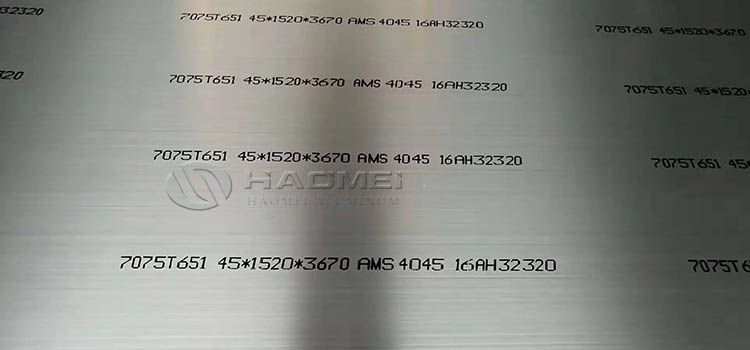
7075-T6 is produced by heating the alloy to a specific temperature to dissolve the strengthening phase, rapidly cooling to fix the solute atoms, and then holding at a low temperature to allow the strengthening phase to precipitate uniformly, ultimately forming a stable microstructure. This treatment method gives 7075 T6 "comprehensive and balanced" high-strength performance. What are aluminium alloy 7075 t6 properties?
Extreme static strength: This is the core advantage of the T6 condition. Its tensile strength can reach 572 MPa, and its yield strength is as high as 503 MPa. This data means that it can withstand extremely high static loads, performing exceptionally well in scenarios subjected to stable forces such as pressure and gravity, such as structural components in the aerospace field and load-bearing components of high-end mechanical equipment.
Good machinability: After T6 treatment, the alloy has moderate hardness (approximately 150 HB Brinell hardness). Although not as easy to machine as the annealed state, it can still achieve high machining accuracy for conventional machining operations such as drilling and milling, meeting the manufacturing requirements of precision parts, provided appropriate tools and parameters are selected.
Limitations to consider: The T6 alloy contains certain internal stresses. In machining complex shapes or under long-term vibration loads, there may be a risk of stress cracking. Therefore, it is not suitable for manufacturing parts with complex shapes that need to withstand alternating stresses.
The T6511 state is based on the T6 treatment with an additional "tensile stress relief" step. Before artificial aging, the alloy undergoes a certain degree of stretching (typically with elongation controlled at 1%-3%) to release internal stress through plastic deformation. This small modification makes its performance more suitable for machining scenarios, with a core highlight focused on "machining stability":
Superior stress control: After eliminating internal stress, the 7075 T6511 alloy exhibits extremely low deformation during machining, especially during large-area milling and thin-walled machining. Stress release prevents warping and deformation of parts, ensuring stable dimensional accuracy, which is crucial for products with high shape accuracy requirements, such as automotive molds and precision instrument housings.
Strength comparable to T6: The stretching process has almost no impact on the alloy's strengthening effect. The tensile strength and yield strength of T6511 are essentially on par with T6 (tensile strength approximately 565 MPa, yield strength approximately 496 MPa). While ensuring machining stability, it still meets high strength requirements, achieving a balance between "high strength + high machinability."
Significantly improved crack resistance: The elimination of internal stress significantly enhances the resistance of T6511 to stress corrosion cracking. Even in humid or corrosive environments, or under certain vibration loads, it reduces the risk of cracking, making it more suitable for manufacturing marine engineering equipment components, outdoor precision mechanical parts, etc.
Choose 7075 T6: When the part shape is simple, mainly bears static loads, and has low requirements for deformation after processing, with a greater emphasis on ultimate static strength, such as aerospace structural supports and heavy machinery load-bearing shafts, T6 is a cost-effective choice.
Choose 7075 T6511: When the part shape is complex, requires precision machining (especially thin-walled, large-area milling), or needs to be used in complex environments, with high requirements for dimensional stability and crack resistance, such as lightweight automotive structural parts, precision molds, and high-end medical device parts, T6511 better avoids processing losses and usage risks.
Original Source:https://www.aircraftaluminium.com/a/what-are-aluminium-alloy-7075-t6-t651-properties.html
Tags: 7075 aluminum plate ,
Contact Us